
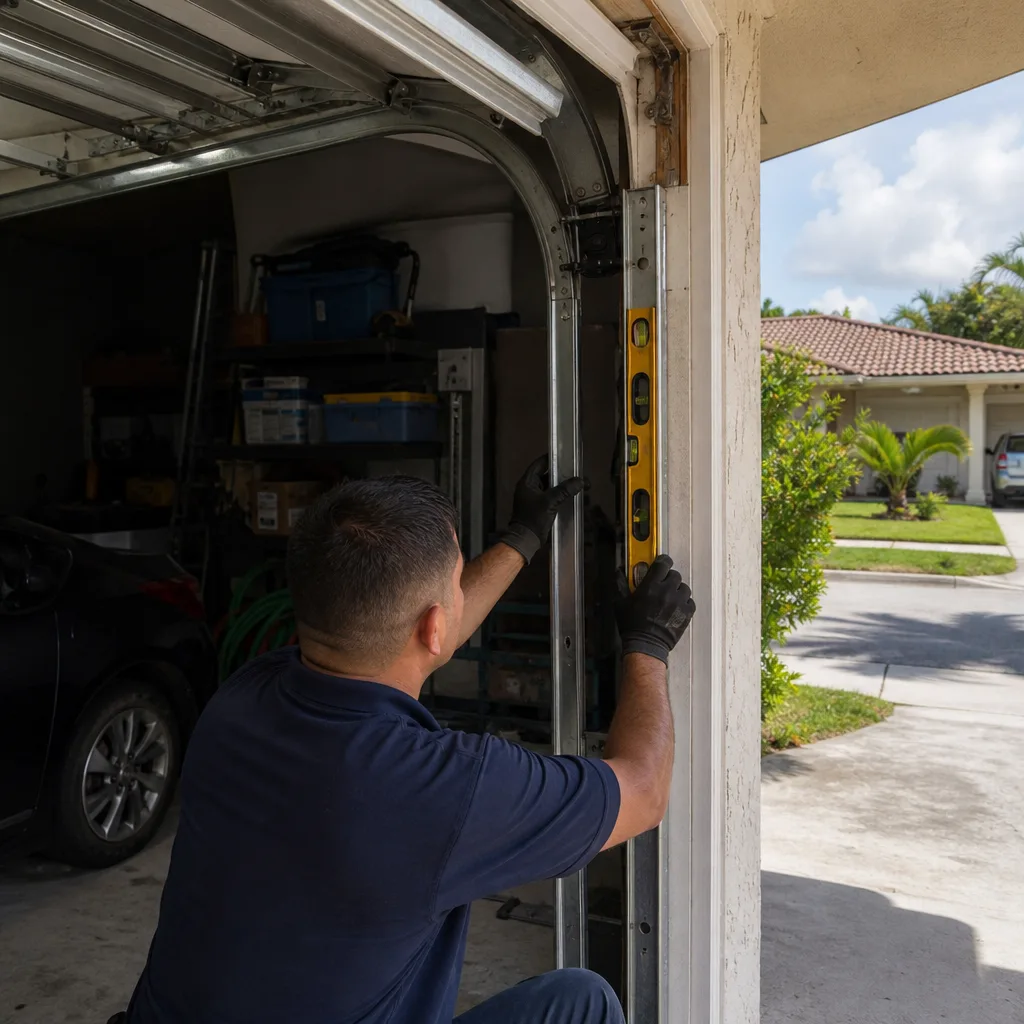
Last updated October 16, 2026
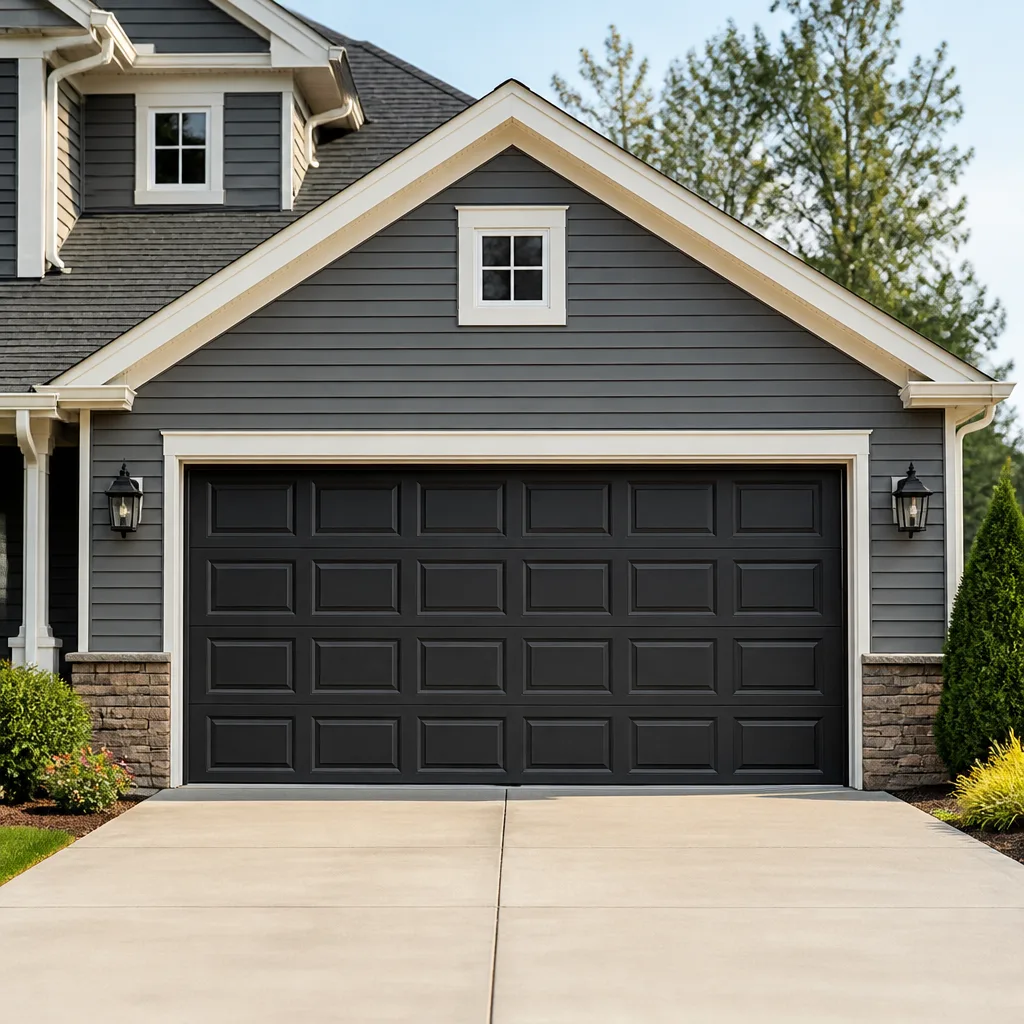 Raised-panel steel
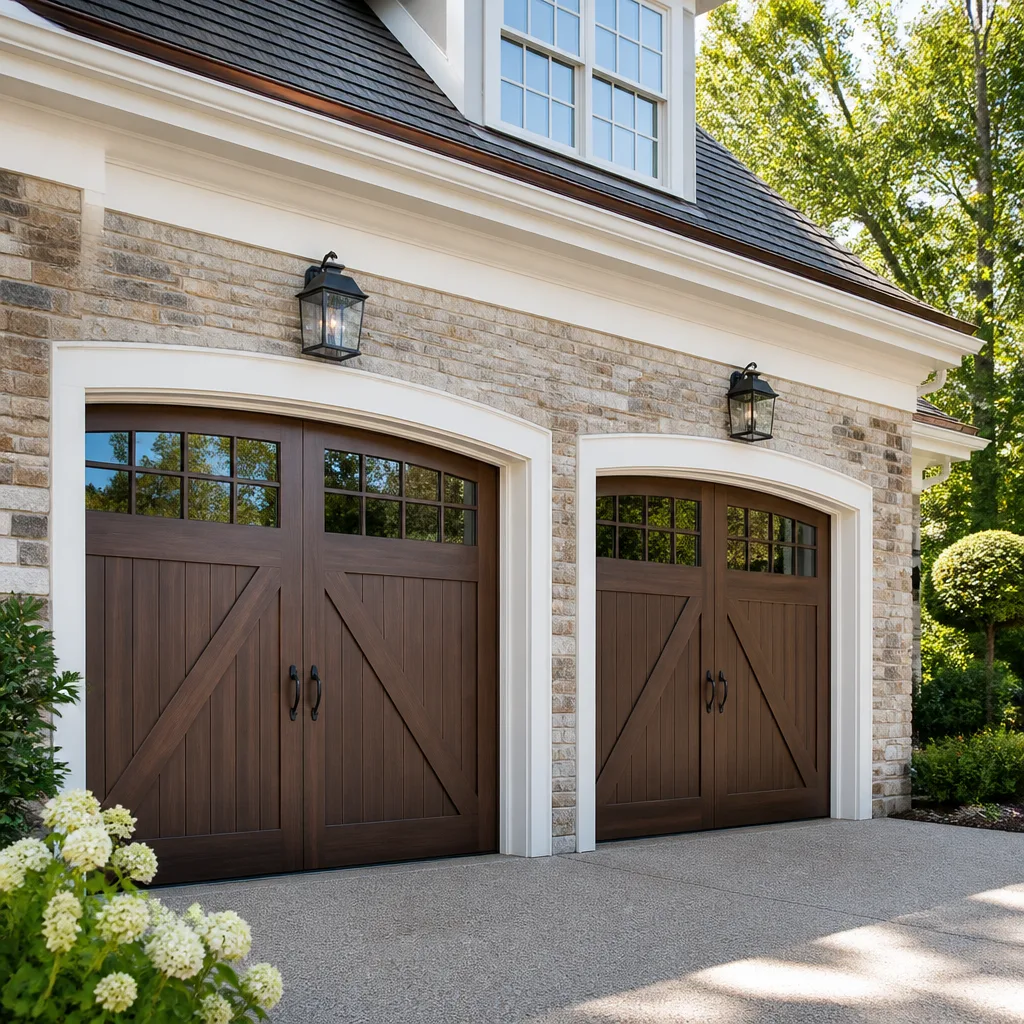 Carriage house
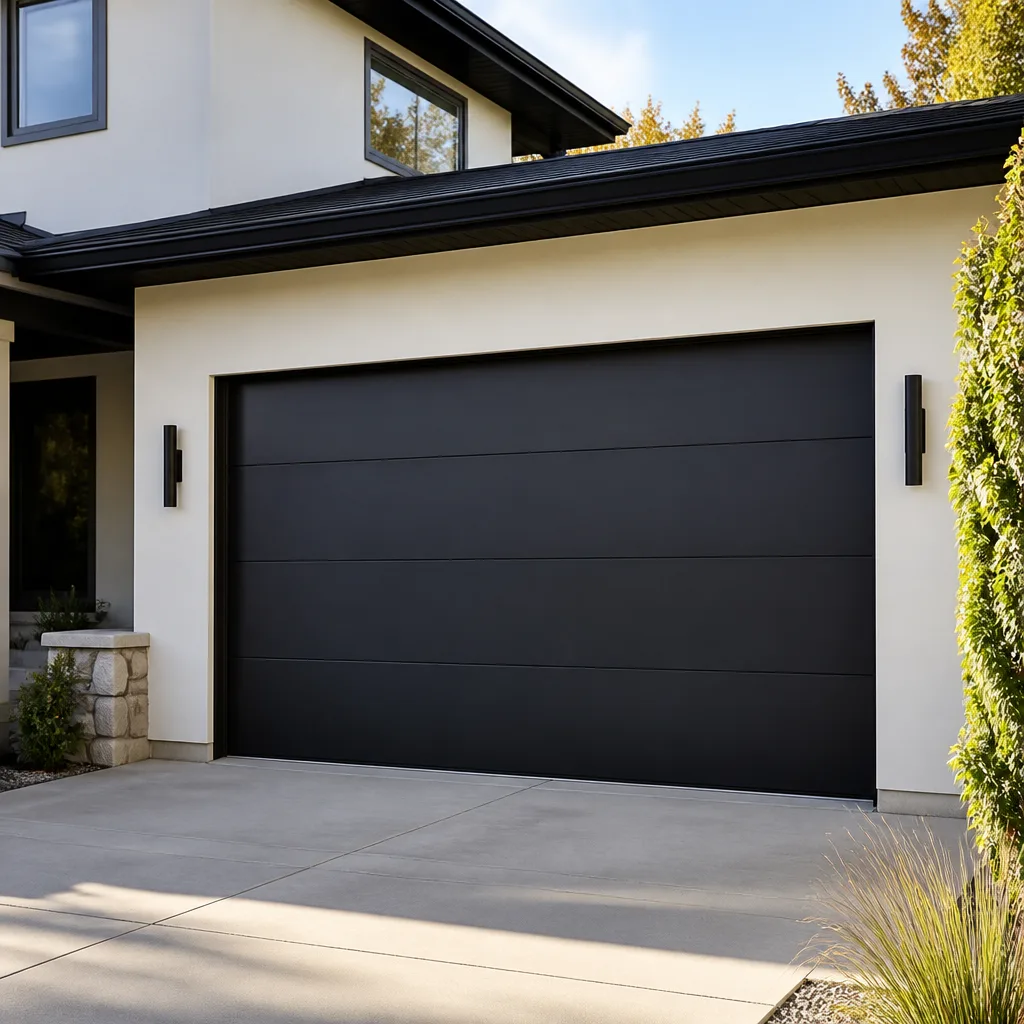 Modern flush
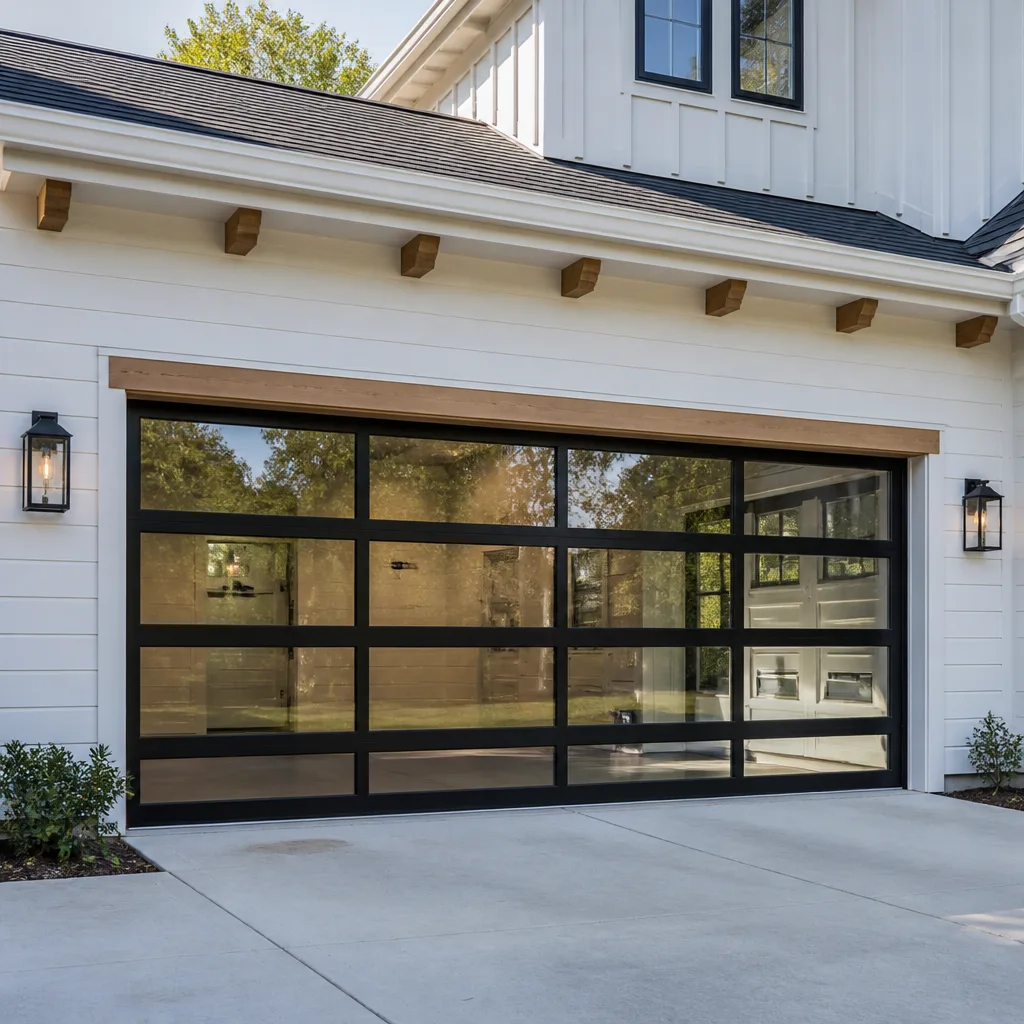 Full-view glass
 LiftMaster openers
 Chamberlain openers
Full 25-point door and opener safety check with every visit - springs, cables, rollers, tracks, and your LiftMaster or Chamberlain opener included
You get a price before we start. It does not change when the truck arrives.
Get your free estimateGarage Door Repair Maintenance Checklist for Fort Lauderdale Homeowners
The average garage door spring is rated for 10,000 open-and-close cycles. In most of the country, that works out to roughly seven to nine years of service. In Fort Lauderdale, coastal humidity and salt air can cut that lifespan by a third, which means the spring that was fine in March may snap on a Tuesday morning in August. This guide walks through the maintenance tasks that actually matter for Broward County homes, the ones that generic checklists skip, and the ones that keep a door running through hurricane season and the rainy months that follow.
Styles & brands we work with
Quick Answer
A Fort Lauderdale garage door maintenance checklist should include monthly salt-air hardware inspection, a rainy-season bottom seal test, hurricane-prep tasks completed before June 1, auto-reverse force testing, and a written service record from your technician. Most local doors fail early because one of these five tasks gets skipped. A proper Garage Door Repair maintenance visit takes under an hour and catches the problems that turn into $300-plus repairs later.
Table of Contents
- Salt-Air Corrosion Check: The Monthly Hardware Inspection
- Rainy-Season Bottom Seal Test: What South Florida Water Actually Does
- Hurricane-Season Prep: The Before-June-1 Checklist
- How to Test Auto-Reverse Force Settings Correctly
- What Your Technician Should Document in Writing After Every Visit
- A Month-by-Month Maintenance Schedule for Fort Lauderdale
- What You Can Do Yourself vs. What Needs a Trained Technician
- Common Mistakes to Avoid
- When to Call a Professional
- Frequently Asked Questions
- The Bottom Line
Salt-Air Corrosion Check: The Monthly Hardware Inspection
If your home sits within a mile of the Intracoastal Waterway or the Atlantic, your garage door hardware is living in a salt bath. It is not dramatic to say that. The same corrosion that eats boat fittings and outdoor light fixtures is working on your hinges, rollers, brackets, and springs every single day. The fix is a five-minute visual inspection once a month, and it catches problems while they are still cheap to address.
Here is what to look at, in order of how often we find trouble in Fort Lauderdale:
- Bottom brackets – These carry the lift cables and sit at the lowest point of the door, which is where salt-laden air and standing water both collect. Look for white or greenish crust around the bolt heads, and rust streaking down from the bracket itself.
- Rollers – Steel rollers rust first at the stem, the thin shaft that inserts into the hinge. Nylon rollers hold up better, but their ball bearings still corrode in salt air and will start to grind. LiftMaster and Chamberlain doors commonly ship with nylon rollers from the factory.
- Hinges – The center hinges and end hinges flex with every cycle. Surface rust on the hinge body is cosmetic at first. Rust forming between the hinge leaf and the door section means the metal is expanding and loosening the fasteners. That is a structural problem.
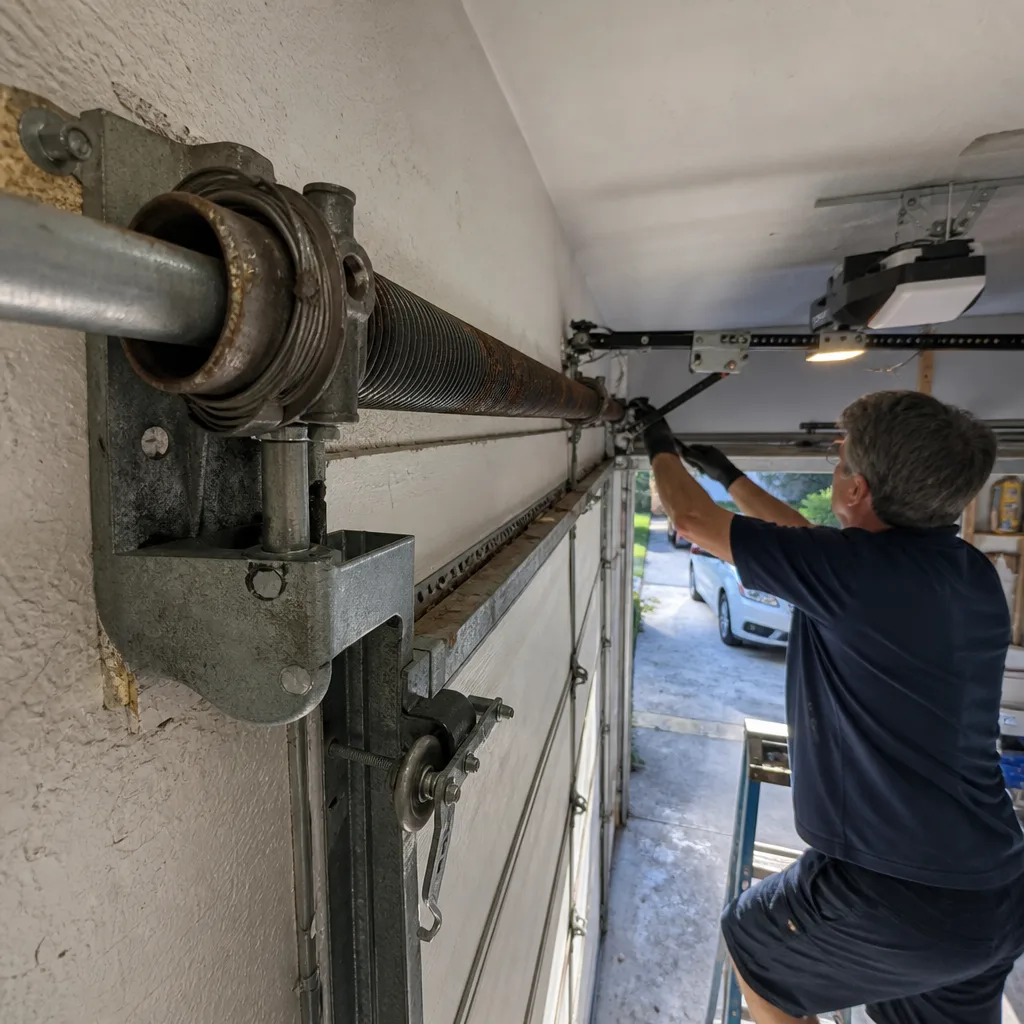
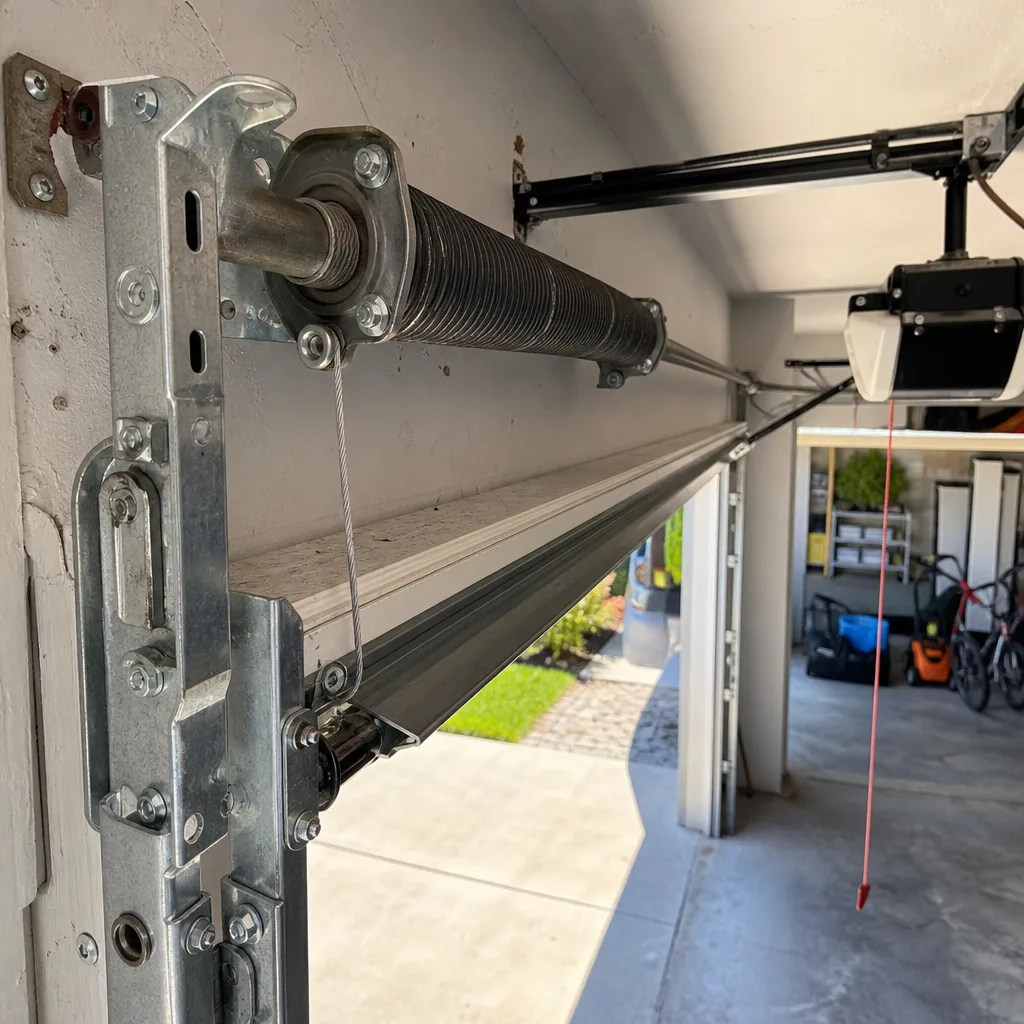
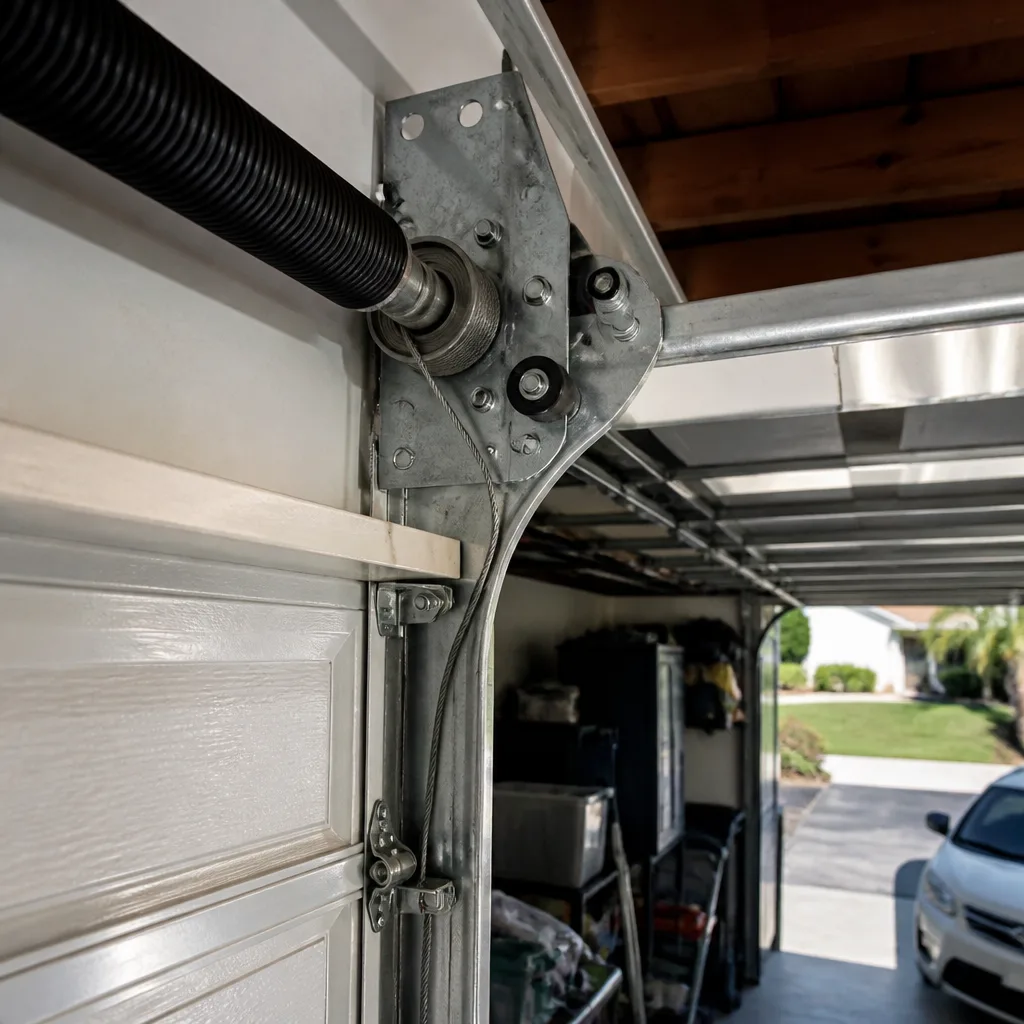
- Springs – Torsion springs, the thick coiled springs mounted above the door that bear most of the lifting load, show corrosion as a fine orange dust on the coil surface. Once rust pits the spring wire, the spring is weakened and a snap becomes a question of when, not if.
- Lift cables – The cables run from the bottom brackets to the drums at the top of the shaft. Frayed strands, kinks, or rust spotting anywhere along the run means the cable needs replacement. A snapped cable drops the full weight of the door onto whatever is below it.
Wipe down accessible hardware with a dry cloth and apply a light coating of garage door lubricant to rollers and hinges when you hear grinding. Do not spray the springs with household oil, and leave any cable work to a pro. The torsion spring and cable assembly is under enough tension to cause serious injury. This is one area where a visual check is the right move, and hands-on work is not.
We service Brock Garage Doors Fort Lauderdale home with a focus on coastal hardware failures because that is the failure pattern this climate creates. A homeowner who checks brackets monthly will catch most problems before they strand a car in the driveway.
Rainy-Season Bottom Seal Test: What South Florida Water Actually Does
Fort Lauderdale receives over 60 inches of rain in an average year, most of it arriving between June and October in heavy afternoon downpours. The bottom seal on your garage door, the rubber strip that runs along the lower edge, is the only thing standing between that water and everything stored on your garage floor. A seal that is cracked, flattened, or pulling away from the door lets water push through during a hard rain, and in low spots, it pools against drywall, cardboard boxes, and tool cabinets.
Test your bottom seal after the first week of heavy rain each season, then again in October as the rainy season ends:
- Close the door fully and let it settle for 30 seconds.
- Walk the interior perimeter with a flashlight on an overcast day or after dark. Light visible under the seal means a gap that water will find.
- Get down at the corners. The two outside corners are the failure point we see most in Fort Lauderdale. The seal pulls away from the metal retainer as the rubber shrinks and hardens in the heat.
- Run a hose at low pressure along the outside base of the closed door for two minutes. Then check inside for any dampness at the floor line. This is the only test that simulates an actual South Florida downpour.
- Check for gaps behind the weatherstrip. Water does not only go under the seal. It travels along the concrete and can rise through cracks where the floor has settled away from the seal. A worn threshold plate under the door may be needed.
Bottom seals on a two-car door typically run $90 to $180 installed, depending on the seal material and whether the retainer channel needs replacement. That is a small number compared to what water damage costs to remediate in a Fort Lauderdale garage, where humid air means mold establishes within 48 hours of a leak.
This is also the time to inspect the side and top weatherstripping. Sunlight degrades vinyl and rubber in South Florida faster than almost any other climate in the continental U.S. Cracks at the top corners of the door frame let wind-driven rain enter during summer storms, often streaking down the inside face of the door where it goes unnoticed until the wood or metal starts to stain.
Hurricane-Season Prep: The Before-June-1 Checklist
Atlantic hurricane season runs from June 1 through November 30, and Broward County emergency management guidance recommends having your property prepped before the season starts, not when a storm is three days out. Your garage door is the largest opening in the home’s exterior envelope and the single most common structural failure point in a hurricane. A door that fails under wind load allows a pressure differential that can lift the roof off the house.
Complete these tasks before June 1 every year. If you miss the date, do them as soon as you remember. A door prepared in August is still far better than one that was never prepared.
- Verify the door’s wind-load rating. Post-2002 Florida Building Code requires garage doors in Broward County to meet specific wind-load design pressures. If you do not know your door’s rating, the manufacturer’s label is on the inside of the door panel, usually near the bottom section. No label means the door may predate code requirements and should be inspected by a pro before storm season.
- Inspect and tighten all track brackets and mounting bolts. Wind pressure works the door like a sail, and loose brackets allow movement that eventually rips the track from the wall. A 7/16-inch socket and 15 minutes is all this takes for the accessible bolts.
- Check the reinforcing struts. Many Fort Lauderdale doors have horizontal steel struts bolted across each section to stiffen them. Rusted struts, missing bolts, or cracks in the stile metal reduce the door’s wind resistance significantly.
- Confirm hurricane-rated rollers and hardware. Exposed steel rollers corrode in salt air and bind under load. Nylon-encased rollers with sealed bearings hold up better in this climate and are standard on most LiftMaster and Wayne Dalton doors installed since 2010.
- Run a full balance and auto-reverse test (covered in the next section). A door that will not open or close smoothly under normal conditions will not hold up under storm loading.
- Photograph the door, both tracks, springs, and the bottom seal. This documentation is your starting point for an insurance claim if the storm does damage. Date-stamped photos taken before the storm make any post-storm claim substantially easier.
If the door needs work before the season, Garage Door Repair in Fort Lauderdale is a conversation to have well before a storm is in the forecast. The week ahead of a named storm is the worst time to schedule repairs, and most reputable local shops are booked solid. Every repair Brock Garage Doors Fort Lauderdale performs is documented in writing and covered by a written 365-day guarantee, so the pre-season work you do this year carries into next year’s inspection with a clear record.
How to Test Auto-Reverse Force Settings Correctly
The auto-reverse mechanism on your garage door opener is the safety feature that stops the door from crushing whatever is beneath it. It works two ways: the photoelectric sensors near the floor detect anything breaking the beam, and the opener’s internal force sensor measures resistance and reverses when the door hits an obstruction. Most homeowners know the sensor test. Almost none know the force test, and that is the one that fails quietly.
A door with an incorrectly set force limit will keep pressing down against a child, a pet, or a bicycle. It may also fail to reverse on contact with a cardboard box, which means it is pressing hard enough to cause real injury before the motor gives up. In Fort Lauderdale, salt-corroded rollers and tracks add resistance over time, and the door slowly needs more force to move. If the opener’s force setting is never adjusted, the machine compensates by pushing harder, and that creates a safety hazard.
Here is the correct test, which takes under five minutes and should be done monthly:
- Lay a two-inch-thick object flat on the floor in the door’s path. A scrap piece of 2×4 laid flat works well. Do not use something soft like a pool noodle. The door must meet real resistance.
- Close the door using the opener. Watch the door as the bottom edge contacts the object.
- Confirm the door reverses within two seconds of contact and returns to the open position. If the door stops but does not reverse, the force setting is wrong.
- If the door crushes or splinters the 2×4 before reversing, the force limit is set too high. Stop using the door and have a technician recalibrate the opener immediately.
- Repeat the test on the other side of the door. Force sensitivity sometimes varies side to side depending on track condition and roller wear.
Then check the photoelectric sensors. With the door closing, wave an object through the beam between the two sensors, about six inches off the floor. The door should reverse instantly and return to full open without stopping. If either test fails, the door is not safe to leave in service. A proper Garage Door Opener Repair in Fort Lauderdale call includes a full force-setting recalibration and sensor alignment, and the technician should show you the written reading for both sides before he leaves.
What Your Technician Should Document in Writing After Every Visit
Most garage door maintenance visits end with a verbal summary and a receipt. That is not enough in a climate like Fort Lauderdale, where warranty claims and insurance claims are both regular events. A written service record gives you evidence of what was checked, what was replaced, and what was noted as a future concern. Without it, you are relying on memory when something fails.
Here is what a proper written record should include after any maintenance or repair visit in Fort Lauderdale:
- Date and time of service, plus the technician’s name and the company he represents. If something goes wrong later, you need to know who was there.
- A line-item list of every component inspected: springs, cables, rollers, hinges, tracks, bottom seal, weatherstripping, opener, sensors, and mounting hardware. A checklist with a checkmark next to each item, or a notation of condition.
- Specific measurements taken: spring cycle count if estimated, door balance reading, auto-reverse force setting before and after adjustment, and bottom-seal gap measurement if one exists.
- Parts replaced, including brand and part number where applicable. A cable replaced with a LiftMaster part should say so in writing.
- Items flagged as concerns for the next visit. If a spring is showing corrosion but not yet failing, that belongs in the record, with the technician’s recommendation.
- The total price in writing, matching the written price provided before the work started. The number on the invoice should be the same number you approved.
- The warranty terms, in writing. Not a verbal promise. A written guarantee that spells out what is covered and for how long.
This documentation matters in ways that are not immediately obvious. If a hurricane damages your door and you file an insurance claim, a pre-storm service record showing the door was inspected and maintained strengthens the claim. If a warranty dispute arises with a manufacturer, records of professional maintenance are often required to validate the claim. And if a repair fails, a written guarantee from the company that did the work is what gets you a free return visit, not a phone argument about what was said.
We put every one of these items in writing on every job because a verbal assurance evaporates the moment the truck leaves the driveway. The 365-Day Done Right Promise from Brock Garage Doors Fort Lauderdale spells out that if a covered repair fails within a full year, we return and correct it at no additional charge. That promise only matters if it is on paper, and it always is.
A Month-by-Month Maintenance Schedule for Fort Lauderdale
Fort Lauderdale does not have a cold season that shuts doors down and a warm season that brings them back to life. The door works the same way twelve months a year, but the failure pressures shift by month. Here is a schedule built around the actual calendar for Broward County.
January to February: Dry season, mild temperatures. The best months for deep maintenance. Salt corrosion has had months to accumulate, but rain is low and the weather makes a full inspection easy. This is the right time to have the springs, cables, and rollers inspected by a pro and to replace anything flagged in last year’s service record.
March to May: The run-up to hurricane season. Rising humidity starts to work on hinges and rollers. If the door needs reinforcement for a new wind-load rating, or if the bottom seal showed gaps during the last rainy season, schedule the work now, before the June rush. This is also when a complete Garage Door Cable Repair in Fort Lauderdale should be scheduled if any fraying was noted, because cable failure under storm winds is catastrophic.
June 1: Hurricane-season prep complete. All the tasks in the hurricane prep section above should be done by this date, including the photo documentation. If you did not complete them, do them now.
June to October: Rainy season. Monthly bottom seal checks and monthly auto-reverse tests are the priority. Salt air and humidity are at their peak, and hardware corrodes faster during these months than any other time of year. Check the bottom brackets and cable attachment points monthly, not quarterly.
November to December: Post-rainy-season assessment. The heavy rains are done, and the damage they caused is visible. Check for water staining around the base of the drywall, rust on the bottom brackets, and any new gaps in the weatherstripping. Schedule the deep maintenance that will carry the door through the next hurricane season.
What You Can Do Yourself vs. What Needs a Trained Technician
A maintenance checklist is only useful if it distinguishes between the ten-minute homeowner task and the job that can seriously injure someone. We work on doors in Fort Lauderdale every day, and we would rather have a homeowner call us for a free estimate than attempt a spring or cable repair in a garage on a hot afternoon and end up in an emergency room.
Safe for a careful homeowner:
- Visual inspection of brackets, hinges, rollers, springs, and cables
- Bottom seal condition check and the hose test described above
- Light lubrication of rollers and hinges with a garage-door-rated spray lubricant
- Auto-reverse force test and photo sensor test using the steps above
- Tightening accessible track bracket bolts with a socket wrench
- Cleaning the photoelectric sensor lenses with a dry cloth
- Documenting the door’s condition with date-stamped photos
Leave to a trained technician:
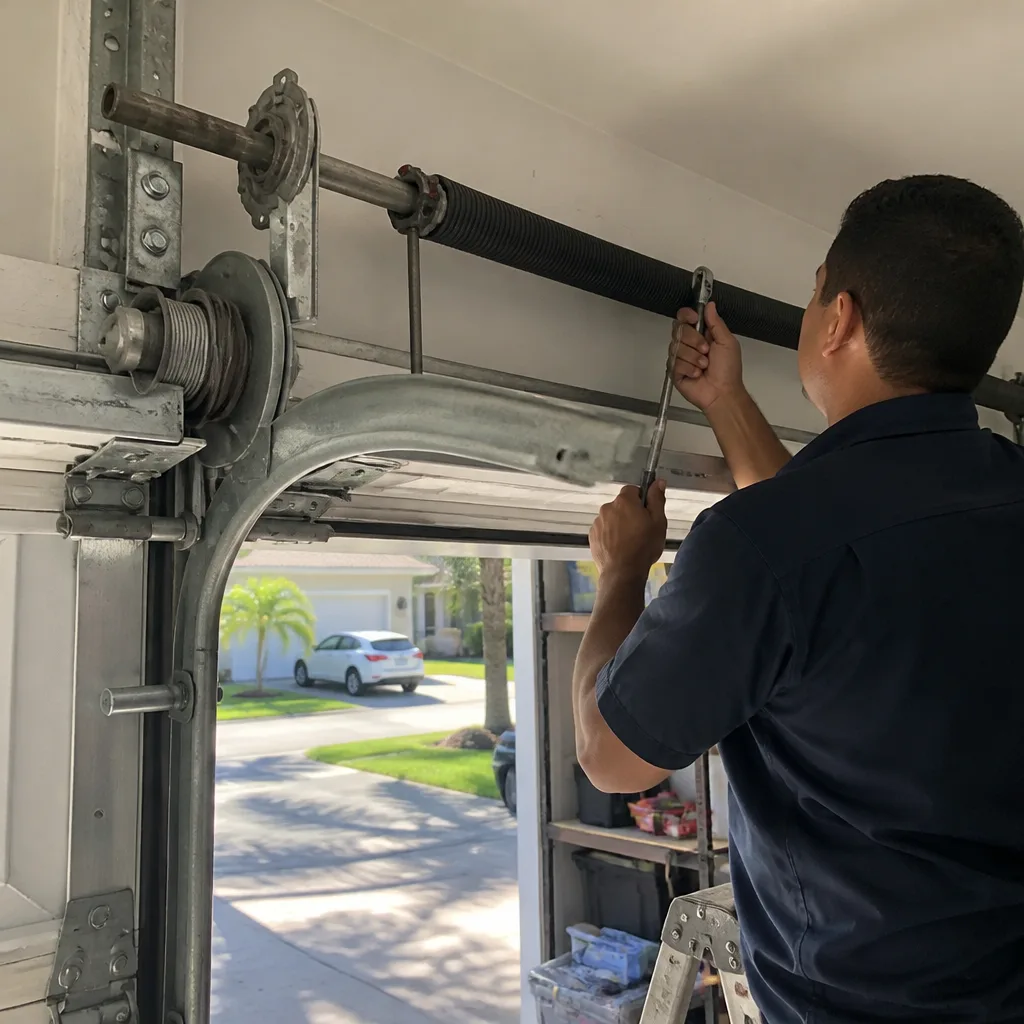
- Any work on torsion springs or extension springs. The torsion spring, the thick coiled spring above the door, carries hundreds of pounds of torque. When it fails, it fails violently. We flag this for every homeowner in Fort Lauderdale because the afternoon heat and the garage environment make a snap more likely, not less.
- Lift cable replacement. The cables play the same tension game as the springs. A cable that lets go under strain moves fast and without warning.
- Track realignment and opener force recalibration requiring tools. If the door is binding against the track or the auto-reverse test fails, the adjustment is not a screwdriver job.
- Any repair involving the opener’s electrical connections or the power head.
- Reinforcing an older door for hurricane wind loads.
The dividing line is simple: if the part is under tension or connected to electricity, call a pro. Wade Mercer, the owner at Brock Garage Doors Fort Lauderdale, has built the company around the idea that a homeowner should never feel pressured to do dangerous work to save a service fee. The free estimate takes the risk out of finding out what the job will cost.
Common Mistakes to Avoid
- Using WD-40 on garage door components. It is a solvent and water displacer, not a lubricant. It strips existing grease and leaves metal components dry, which accelerates corrosion in Fort Lauderdale’s salt air. Use a garage-door-rated silicone or lithium spray instead.
- Skipping the force-setting test. The photo sensor test is only half the picture. A door can pass the beam test and still crush an object with excessive force. The 2×4 test is the one that actually verifies safety.
- Waiting until June 1 to think about hurricane prep. By the first week of June, every reputable garage door company in Broward County is booked. Prep work done in March or April gets you on the schedule and gives you time to address findings.
- Replacing a bottom seal without checking the retainer channel. If the metal channel that holds the seal is bent or corroded, a new seal will not seat properly and the leak will return. In Fort Lauderdale, we see this exact failure on doors within a mile of the water, where the retainer rusts from the inside.
- Ignoring a door that is slightly out of balance. A door that sags on one side or creeps upward when opened halfway is telling you something. Ignoring it means the springs, cables, and rollers all wear unevenly, and a small balance problem becomes a snapped spring or a derailed door.
- Accepting a verbal estimate. If the number is not in writing before work starts, it is not a number. Every repair and maintenance visit from Brock Garage Doors Fort Lauderdale starts with a written price that is agreed to before a single bolt turns.
- Failing to keep the service record. Maintain a folder, physical or digital, with every service document. This is the evidence you need for warranty claims, insurance claims, and knowing what was actually done to the door last year.
When to Call a Professional
Some maintenance findings are maintenance findings. Others are stop-and-call-today findings. If your door makes a loud snap and will not open, that is a broken torsion spring. If the door hangs unevenly or one side sits higher than the other, the cable or spring has failed. If the door reverses before fully closing on every cycle, the force settings or track alignment need professional correction. If the door shakes, rattles, or binds during operation, the problem is structural, not cosmetic. Any of these, and the right move is a professional inspection before another cycle is run. Brock Garage Doors Fort Lauderdale offers free estimates in Fort Lauderdale – call (754) 354-7491 and a live person will answer, day or night.
Frequently Asked Questions
You should do a visual hardware inspection monthly if you live within a mile of the Intracoastal or the ocean, and quarterly if you live further inland in Broward County. The salt air within the coastal band means corrosion moves fast, and monthly checks catch it before it becomes a repair bill.
Most torsion spring replacements in the Fort Lauderdale area run between $180 and $340 per spring, depending on the spring size, cycle rating, and door weight. The number varies enough that a written quote after an on-site inspection is the only honest answer. Brock Garage Doors Fort Lauderdale puts that price in writing before any work begins.
With a written-price-first company, no. The written price is handed over before any work starts, and the invoice matches the number you approved. The practice of quoting low over the phone and raising the price at the door is common in this trade, and it is exactly the behavior that Fort Lauderdale homeowners should refuse to accept.
In most cases, yes. A live person answers the phone at (754) 354-7491 around the clock, including nights, weekends, and holidays, and same-day spring and cable repairs are the norm in our Fort Lauderdale service area. Equipment is carried on the truck for common LiftMaster, Chamberlain, and Genie repair scenarios.
Yes. Our technicians are trained on eight major brands, including Wayne Dalton, Raynor, LiftMaster, and Craftsman. The right fix for a Wayne Dalton TorqueMaster system is different from the fix for a standard torsion setup, and training on the specific system means the work is done correctly the first time.
A maintenance visit in Fort Lauderdale typically costs less than a quarter of an emergency spring replacement, and it catches the corrosion and seal failures that lead to those emergencies. In our experience, a door that seems fine is often 30 to 60 days from a failure that could have been prevented. The visit buys time, a written record, and a door that will actually survive the next rainy season.
The Bottom Line
A Fort Lauderdale garage door lives under conditions that a door in Ohio or Arizona never faces. Salt air, 60 inches of annual rain, hurricane wind loads, and year-round use all work against the hardware, and the maintenance checklist that ignores those conditions is not doing its job. Check the brackets and cables monthly if you are near the water, test the bottom seal after the first heavy rain and again in October, complete hurricane prep before June 1, run the auto-reverse force test every month, and keep every service record in writing. If a task crosses the line into spring or cable work, call a professional before the door makes the decision for you, or explore our more guides & resources for year-round help.
Written by Wade Mercer, Owner at Brock Garage Doors Fort Lauderdale, serving Fort Lauderdale since 2001.
See the difference
 Before
 After
After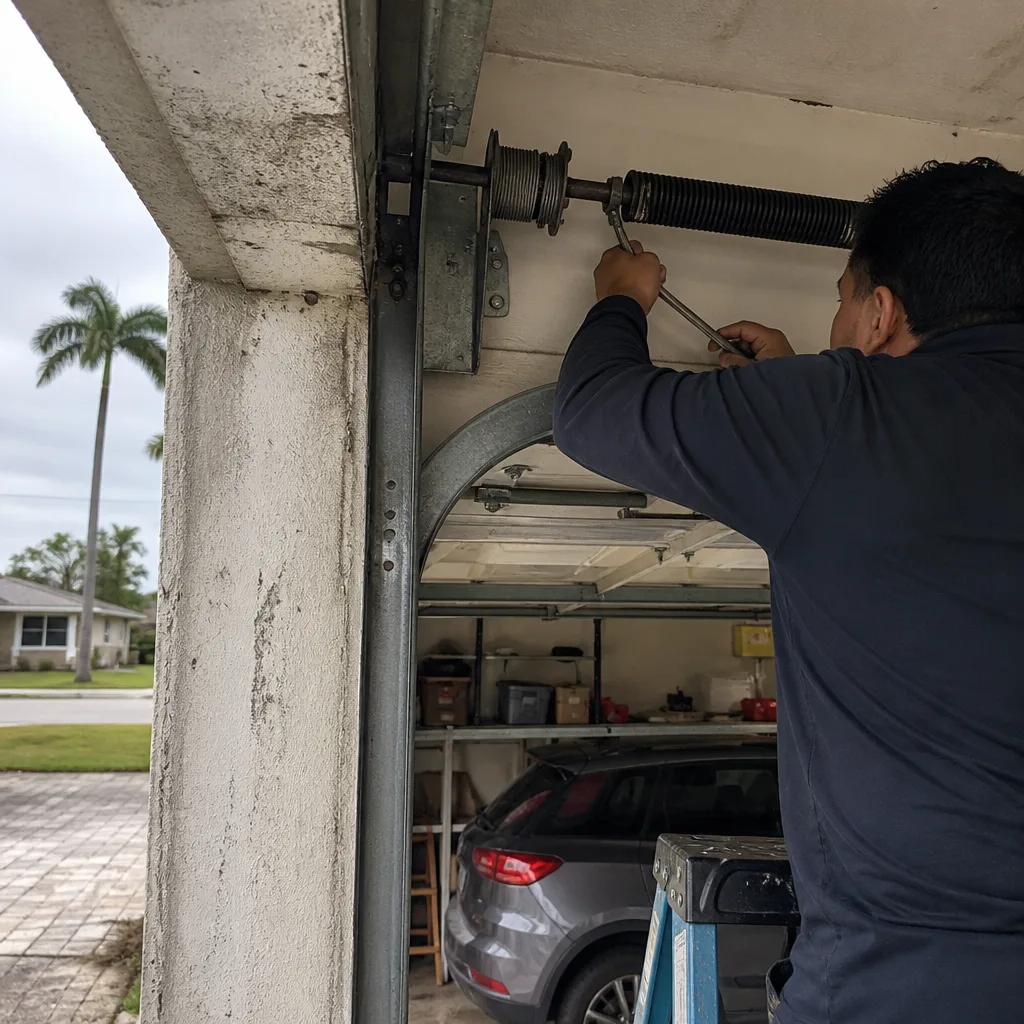 Before
 After
After Before
 After
After